

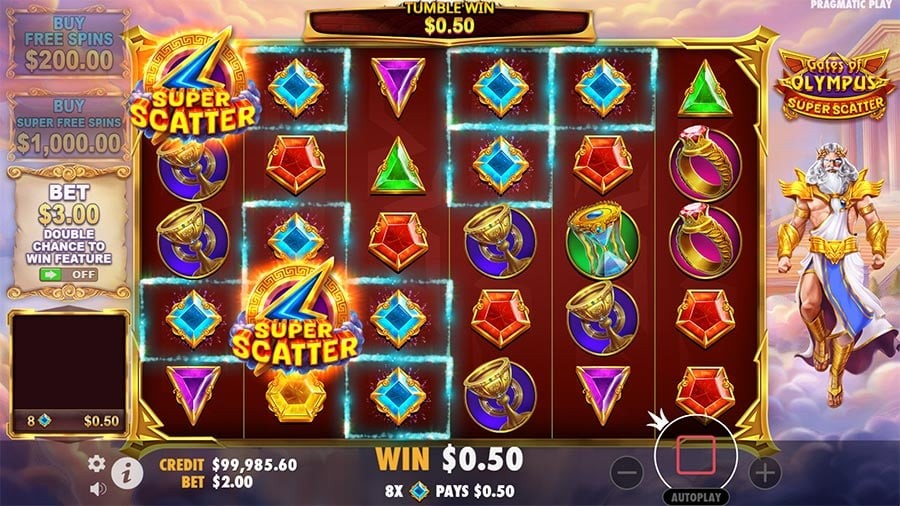






Max Win Gates Of Olympus Super Scatter
Log in, test the pace, and set limits before playing for money in Norway - a calm review for 18+ in 2026.
How To Start Safely In 2026
Imagine opening the game on your mobile during a short break, and you just want to “play a few rounds” before moving on. It sounds simple, but precisely in such short sessions, it's easy to play faster than planned - and to make choices on autopilot. Therefore, start with a quick check: have you decided on time, budget, and a stopping point, or are you playing by feeling? When the frameworks are clear, the rest becomes more comfortable.
In 2026, fast login, biometric options, and friction-free deposits are also common. This provides speed, but it also means you should build in your own friction: a timer, a break between blocks, and a rule that you don't top up in the middle of the same session. The game may be available in Norway on platforms that follow relevant rules and age limits, and you should always play responsibly and only if you are 18+. It's not a formality - it's the basis for ensuring the session doesn't get out of hand.
A practical starting point is to think in “blocks”. Instead of playing until you feel finished, you decide on a block beforehand, stop, and make a new choice. If you notice that you are irritated, impatient, or tempted to change your stake without a plan, it's a signal that you need a break, not more speed.
All promotional incentive structure is clearly stated in writing and/or via electronic means in an easily understood manner. All codes are accompanied by an explanation of what the code is for, who is eligible to use the code, and how it should be used. As such, players are less likely to be confused about what is required of them in order to receive a reward and how the reward will be applied after receiving it. The promotional incentives provided to participants provide them with time to become familiar with the gaming system's mechanics, their interface, and progress, before deciding how deeply they wish to become involved with this platform. Therefore, players are encouraged to participate in an informed manner, rather than being pressured or tempted to act quickly.
Gates Of Olympus Super Scatter Win
Imagine you've seen clips of big wins and now want to experience the same thrill. It's easy to get drawn into the idea that you just need to “hit the right moment”. The problem is that such clips show peaks, not the everyday life between them. A good session is therefore about what you do in the meantime: how you handle quiet periods, small hits, and fluctuations without chasing.
What you can control are three things: stake, tempo, and duration. When you prioritize them, wins become a result of game flow, not a goal you force. If you play without a plan, you might end up increasing your stake during a quiet period, making each round more expensive precisely when you feel most impatient. Instead, choose a stake that gives you room to tolerate slow periods, and use breaks as part of your strategy.
A useful mental exercise is to define what a “good session” means for you today. Is it sticking to a timeframe? Is it stopping when you're ahead, instead of continuing on adrenaline? Imagine you have a nice moment, feel your pulse quicken, and want to “take one more while it's going well”. That feeling is precisely why a stopping point should be set before you start.
Game Flow and Control Before Increasing Your Stake
Imagine you've set aside 30 minutes and want a session that feels orderly, not hectic. It's smart to start by understanding the screen and the tempo before doing anything else. Many players do the opposite: they crank up the speed or stake early to “get to the fun part”. That can provide excitement, but it can also make the session shorter, more expensive, and more impulsive.
Make it simpler: play a fixed series of rounds with a stable stake, take a break, and evaluate. Does the tempo work for you, or do you get restless? Can you stick to the plan without constantly adjusting? By answering these questions, you build a session that can withstand fluctuations, instead of one that is controlled by them.
Understand the Screen Before Chasing Excitement
Imagine you quickly press spin and suddenly something happens that you don't quite understand – a feature, a symbol, a sequence – and you feel like you “missed” the moment. This is often the start of stress, because you want to recreate the feeling without knowing what actually happened. Therefore, take two minutes at the beginning to orient yourself: where do you find information, where do you see your history, and how do you stop autospin?
A calm start provides more control later. Play a few manual rounds and pay attention to how wins and special symbols are displayed. If you jump straight to autospin, you might “play past” the learning and only be left with an impression that everything is going fast. When you know what you're looking at, it becomes easier to stop and start at the right time.
A small trick that works: explain to yourself what you just did in one sentence. If you can't, it's a sign that you should slow down the tempo. That one sentence often makes you stop autopilot and play more consciously.
Stake Level That Keeps You Calm
Imagine you choose a stake that makes you check your balance after almost every round. Then the stake is probably too high for your session, because every fluctuation feels like a decision with consequences. Instead, choose a level where you can play an agreed-upon block without feeling like you “have to do something” for it to go well.
Stable staking is underestimated. When you maintain the level long enough, you get an honest picture of the fluctuations, and you don't have to interpret everything as signs. If you change your stake every time it gets quiet, you often end up making the session more expensive precisely when you are least patient. That's a bad combination.
A practical stop signal: if you feel like increasing your stake without having decided to do so before the session, take a break. Not because you “have to,” but because you want to make the choice with a calmer mind.
Imagine you start a long session and think you'll stop when you get bored. That sounds fine, but “bored” often comes too late, because you're already in the flow. Instead, break up the session: a short series of rounds, a break, a new choice. The break doesn't have to be long – a glass of water and a glance at the timer is enough.
This structure also gives you more natural stopping points. You stop while you still have control, not only when you're frustrated. Many find that they actually choose to stop when they break the rhythm, because they realize they were actually finished a bit earlier.
If you're playing on mobile, this is extra useful. Mobile makes everything faster, and quick sessions without breaks can easily become longer than you thought. Blocks give you a brake that doesn't feel heavy.
Imagine you get a strong sequence and feel that “now it's flowing.” That's exactly when many continue for too long, because they want to prolong the feeling. A smarter response is to stop for a minute, check your plan, and decide again. If you continue, do so within the same framework, not with new exceptions.
A good choice is to have a rule for high-pulse moments: either you end the entire session when you reach a certain level, or you reduce your stake and play more calmly. The goal is not to let adrenaline dictate tempo and cost.
If you notice yourself starting to “chase back” after a peak that was followed by losses, it's a clear signal that you should stop. Chasing losses feels logical in the moment, but it's rarely a good idea.
Account, Payment, and Limits in Norway
Imagine you have a good session and want to finish neatly, but you encounter an extra step because account information isn't ready or because the payment method requires verification. It's always more annoying when you're already mentally done. Therefore, it pays to make account flow part of the setup, not something you do on the fly.
In Norway, you should keep gambling responsible and within 18+. Set limits before depositing money, and choose a payment solution that makes it easy to stop, not just easy to continue. A little friction can actually be an advantage, because it gives you a second to think before making new choices.
Additional Offers and Requirements Without Confusion
Imagine you activate an offer because it looks good, and then later discover that you have to follow specific terms before you can withdraw. Many get frustrated then, but often it's because they didn't translate the rules into “what does this mean for me tonight?” Make it simple: read the most important points, rewrite them into one sentence, and decide if it suits your session.
You don't need to be a lawyer. You just need to know how requirements affect your stake, time, and flexibility. If you're planning a short session and want to be able to finish without extra steps, it might be better to play without additional offers. It's not “bad,” it's just a choice that suits a calm evening.
If you notice that you get stressed by requirements and rules, it's a sign to simplify. Gaming should be entertainment, not administration. When you keep it simple, it also becomes easier to follow your own limits.
Payment Choices That Support a Tidy Conclusion
Imagine that depositing is so easy you can top up in seconds. That might feel convenient, but it can also make it difficult to stop when you're in a bad mood. Therefore, choose a method you understand and can control, and stick to one solution at the start. Frequent changes can create more clutter in your history, and that's rarely what you want in the middle of a session.
A good move is to decide “one deposit per session.” This automatically makes the session more predictable, and you avoid the classic spiral of small top-ups. If you want to play more, you can take a break and start a new session another day – with a new assessment of budget and time.
|
Topic |
What You Should Check |
Why It Matters |
Calm Habit Advice |
|
Deposit |
Confirmations and Amount Limits |
Prevents errors and impulses |
Start low, keep steady |
|
Withdrawal |
Minimum and order |
Provides a predictable conclusion |
One request at a time |
|
Verification |
Legibility of documents |
Reduces later stops |
Do it early, calmly |
|
Security |
Device and login |
Protect account on mobile |
Log out after the session |
|
Limits |
Time and loss frame |
Stops drift and chasing |
Set before you play |
Withdrawal and Account Check in the Correct Order
Imagine you decide to withdraw, but become impatient and send multiple requests or change details along the way. This often creates more confusion. Instead, do this in a calm sequence: stop the session, send one request, and log out. If you keep playing “while you wait,” the chance of giving back winnings increases.
You should perform an account check when you are not stressed. Take clear photos, check that everything is legible, and use the same information as in your profile. If something gets stuck, note the time and status message before contacting support. This provides faster help than trying many things in a panic.
A practical closing routine helps: after sending the request, switch activities for five minutes. This small transition breaks the game mode and makes it easier to stick to the decision to stop.

Maxwin Gates Of Olympus Super Scatter
Imagine you enter a session with one goal: to hit an extreme peak. This can create excitement, but it can also lead to playing for too long and changing stakes based on emotion. A better way to think is to view the max payout as a design ceiling, not a plan. You play for entertainment and opportunity, but you build the session around control.
In 2026, it is especially important to have structure because everything is so accessible: quick sessions, quick payments, quick temptations. When you combine high excitement with zero friction, it's easy to lose perspective. Therefore, you should use the tools: time limits, deposit limits, breaks, and potentially self-exclusion if you notice recurring patterns.
Max Payout as a Ceiling, Not a Plan
Imagine thinking, “if I just play a little more, it will come.” That thought feels logical, but it makes you vulnerable to chasing. Each round is a new random outcome, regardless of what happened before. When you accept that, it becomes easier to stop without feeling like you “were close.”
What you can do is decide in advance how long you want to be in the game. If you want excitement, you can still get it, but you do it within a frame you can tolerate. If you notice yourself starting to negotiate with yourself about time or amount, it's a sign that you should stop or take a time-out.
A simple rule often helps: no change of stake during a quiet period. If you want to change something, do it only after a break, not in the midst of emotion.
Bankroll Plan for High Excitement
Imagine you set aside an amount that was actually meant for something else, and you promise yourself you'll “just take a little.” Then the pressure becomes higher from the first spin. Instead, use an amount you can afford to lose without thinking about it for the rest of the week. This makes you calmer, and calmness is often what helps you follow your plan.
Divide the amount into blocks. Not because you should play more, but because the blocks give you more natural stopping points. After each block, ask: do I want to continue, or was this enough? If you continue, do so with the same stake, not by increasing everything because you are impatient.
If you have a good moment early on, consider securing an exit instead of “exploiting the flow.” Flow can be fun, but it can also trick you into playing longer than you intended.
Quick Mode, Autospin, and Mobile Habits
Imagine playing with one hand while replying to messages with the other. It's easy to tap faster, lose track, and play longer than planned. Mobile makes it easy to get in - and easy to stay. Therefore, you should build in awareness: shorter sessions, clear breaks, and a habit of logging out.
If you use autospin, use short series and stop between them. Check your balance and mood before starting a new series. If you notice irritation, take a break instead of “playing your way out of it.” Irritation is a poor decision-making engine.
In 2026, biometric login is common, and it can make everything very frictionless. Combine it with good habits: screen lock, no device sharing, and take security alerts seriously if you receive them.
Pause Tools: Time-Out and Self-Exclusion
Imagine you notice a pattern: you automatically open the game when you're bored, or you keep playing when you actually want to stop. In that case, time-out is a practical tool, not a dramatic decision. Use short breaks early, before you get irritated or start chasing.
If the same thing happens multiple times, a longer self-exclusion might be appropriate. The goal is for playing always to be a choice, not a reflex. And that choice should be 18+ and within your own limits in Norway.
A small everyday rule can also help: if you can't follow a simple plan for time and budget, it's a sign that you need a break, not a new session.
Summary for an Orderly Session
Imagine you want to end the evening feeling like you had control, regardless of whether you won or lost. You achieve this by shifting focus from “the one big peak” to “an orderly process”: start calmly, keep stakes stable, play in blocks, and stop at the planned time. When you do that, excitement becomes part of the entertainment, not a pressure.
In 2026, it is especially important to create your own boundaries because everything is fast. Use time limits, deposit limits, and breaks, and make withdrawals part of your closing routine. Play only if you are 18+ and it feels like a conscious choice. If it doesn't, a break is often the smartest thing you can give yourself.
Next Step: Test, Set Limits, Play Calmly
Imagine taking the next session as an experiment, not a project you must “succeed” with. Set a timer, choose a budget, and decide one clear stopping point before you start. Play a short block, take a break, and only continue if you still want to - within the same framework. This way, the experience becomes more stable, and it becomes easier to log out calmly.
FAQ
How do I set a time frame I actually follow?
Start with a short session and use an alarm that interrupts the flow. When it rings, stop and make a new choice calmly, instead of continuing automatically. Many find it most effective to divide the session into two blocks with a break in between.
What is a clear sign that I should take a break?
If you get irritated, click faster than you think, or feel like increasing your stake without it being planned, it's a clear stop sign. A short break often breaks the urge and allows you to see the situation more soberly.
How do I avoid chasing losses during a quiet period?
Keep stakes stable and use breaks as a rule, not an exception. If you feel the need to “fix” the session with a higher stake, stop and take a break before doing anything more. Often, the best choice is to end for the evening.
When is it smart to play without promotions or additional offers?
When you want a short and flexible session, or when you know that terms and conditions stress you out. It can be better to keep it simple and end neatly than to feel like you have to play longer to “complete” something.
What should I do before depositing money in Norway?
Check that account information is tidy, that you know where to find limits and pause tools, and that you have a plan for time and budget. Deposit an amount you can afford to lose, and only play if you are 18+ and within your own limits.
How do I make withdrawals less stressful?
End the session first, send one request, and log out so you don't keep playing while you wait. Avoid changing details during the process, and note the time and status message if something stops, which will make it easier to get help.
Which mobile habits provide the most control in 2026?
Short sessions, clear breaks, and logging out after playing are the most important. Combine it with screen lock and not sharing your device when logged in, and use notifications for security - not as a reason to start a new session.